Chatbots that answer from your documents, not from guesswork
Retrieval-augmented generation grounds every answer in your own approved content — policies, product information, documentation and SOPs — so responses are accurate and traceable.
A general-purpose chatbot does not know your business
A model with no access to your content can only produce plausible text. For internal support, customer service or sales enablement, plausible is not good enough — an answer that sounds right and is wrong costs more trust than no answer at all.
- Answers invented when the model has no grounding
- Knowledge scattered across drives, wikis and inboxes
- The same questions answered repeatedly by the same people
- No way to tell where an answer came from, or whether it is current
What we build
We build the retrieval layer first, because retrieval quality — not model choice — is what determines whether a RAG system is usable. Documents are chunked, embedded and indexed so the model answers from your approved content, and can say when it does not know.
- Document ingestion from your existing sources
- Chunking and embedding tuned to your content, not defaults
- Answers grounded in retrieved passages, with sources shown
- An explicit escape hatch to a human when confidence is low
- Evaluation against real questions before launch
How the engagement runs
Content audit
We review what documentation exists, what is current, and what the system should never answer from.
Retrieval build
Ingestion, chunking and indexing, tested against the questions your team actually receives.
Interface and guardrails
The chat surface, plus the rules for when it should decline and escalate instead.
Evaluation and launch
We test against real queries, tune retrieval, then deploy to the channel where the questions arrive.
Related work
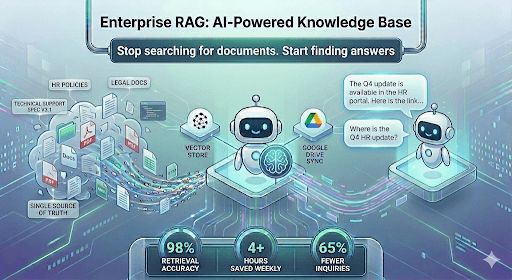
Enterprise RAG: AI-Powered Knowledge Base
Turning Fragmented Company Documents into a High-Intelligence Internal Oracle
Read the case study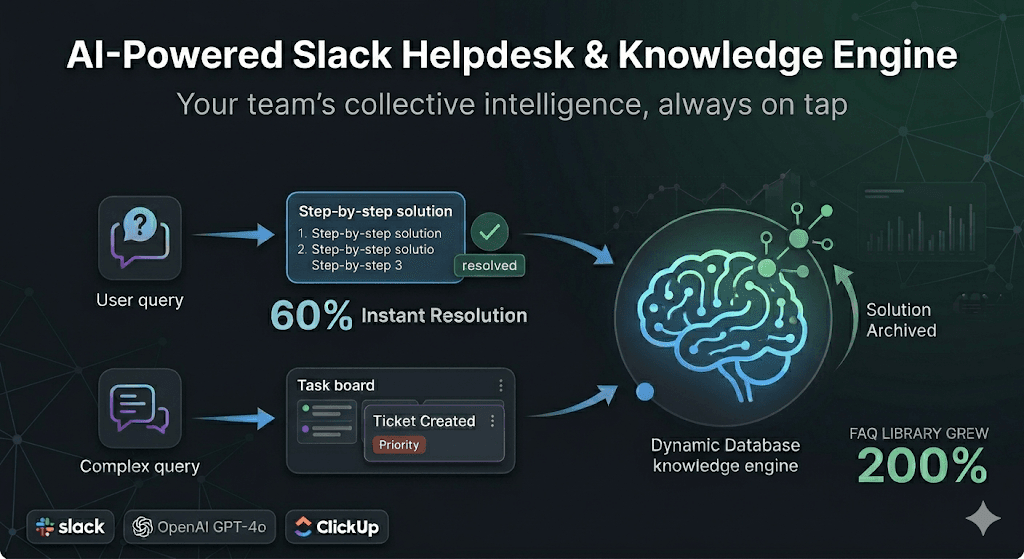
AI-Powered Slack Helpdesk & Knowledge Engine
Transforming Chaotic Team Requests into a Self-Learning Internal Support System
Read the case study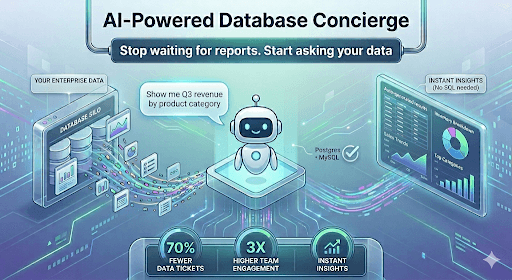
AI-Powered Database Concierge
Unlocking Enterprise Data Through Natural Language Conversations
Read the case studyFrequently asked questions
What is RAG, in plain terms?
What document formats can you ingest?
How do you stop it from making things up?
What happens when it cannot answer?
Where does our data go?
How do you keep it current as documents change?
Tell us what you want to automate
A short call to scope the workflow, followed by a written proposal with scope, timeline and cost before any work begins.